| Galapagos
Islands .com > Galapagos
Tours > Scuba Diving
Galapagos SCUBA Diving
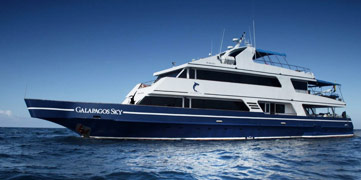
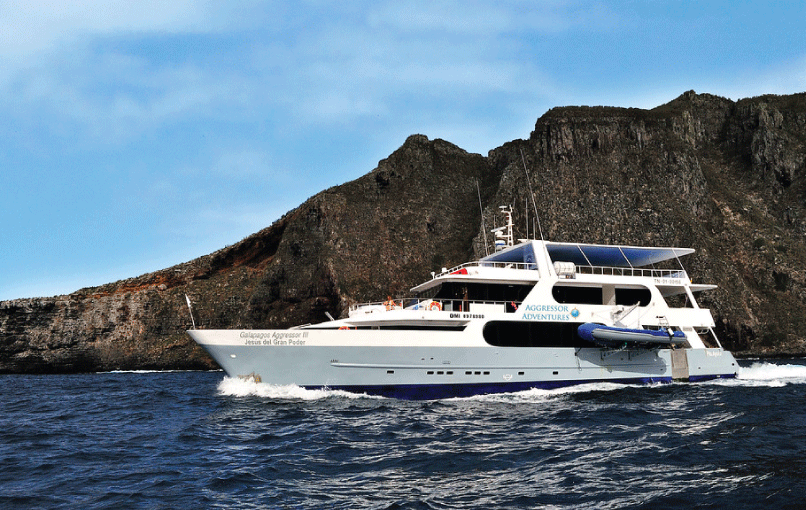
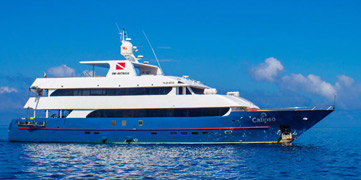
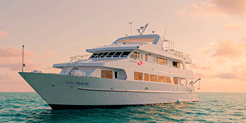
Choose a yacht for Galapagos diving:
Recently, the Galapagos National Park enforced live board diving restrictions to most boats in the Galapagos, currently the Aggressor I and II, and the Sky Dancer are the only boats approved for live aboard diving cruises.
Land-based diving in the Galapagos is going stronger than ever and does have its advantages. Take a look at the land-based diving page, to explore this option.
Contact us about Diving in the Galapagos
|
Major Update August 2007 - The majority of live-aboard diving boats' licenses have been revoked by the Galapagos National Park director. We highly recommend you consider a land-based diving trip instead of live-aboard. If you have already reserved a live-aboard trip, please contact your tour operator for details.
Galapagos SCUBA Diving
The Galapagos Islands were chosen
by Rodale's Scuba Diving as the world's top all around dive
site for the year 2000. The Islands were also chosen for the
top spot in "Best Fish Life", "Best Big Animal
Dive", "Best Advanced Diving" and scored among
the top as the "Healthiest Marine Environment",
and "Best Value".
Most people book their Galapagos diving
trip as a complete package on a live-aboard boat, although
trips based out of Puerto Ayora offer consistent quality guides
and safety standards. To explore the advantages of each, see
our sections: live-aboard
or land-based diving.
All diving tours in Galapagos Islands .com are coordinated
by diving guides who are licensed by the Galapagos National
Park Service and are highly knowledgeable about the underwater
wonders of the Galapagos.
Wonder of the Underwater World
Named
one of the Seven Underwater Wonders of the World by CEDAM
international, the Galapagos waters will make you wish that
you could somehow shout out through your regulator to your
diving partners all the wonders you see.
Imagine a realm where penguins swim in
equatorial seas, no one bats an eye at four-eyed fish, and
iguanas are found eating their algae meal submerged in the
saltwater. Imagine dolphins leaping about in phosphorescent
water and becoming the new friend of a playful sea lion pup.
Open your eyes... you are imagining diving the Galapagos.
Marine
Fauna
Some consider the Galapagos the premiere spot for seeing large
marine fauna. Seeing pelagic species so close to shore
is more common in the Galapagos than most any dive site in
the world. Like the animals on land, the animals that
inhabit these waters have not evolved with a sense of fear
of humans, and your presence will seem no more than a curiosity
to these animals.
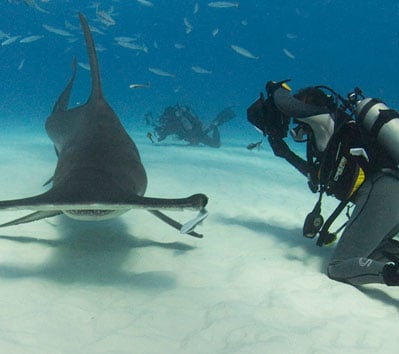
The sharks that patrol these waters are
timid and by no means dangerous, the sea lion pups that you
see basking and awkward on the beaches are graceful and playful
in the water; and spotted rays glide past you in the azure
environment. One in every four marine species is endemic,
making the varieties of angelfish and even chub in the water
a marine biologist's jackpot. And after all, where else
can you observe equatorial penguins diving with marine iguanas?
Mutable
Waters
Diving in the Galapagos is not recommended for first-time
divers. Recently noted in one diving magazine as one of the
world's 10 most difficult recreational dive sites, many dive
operators in the Galapagos take their clients on an easy initial
dive to take note of their ability and let them orientate
to the sometimes unexpected waters. Diving is often straightforward
but the strong currents and the low visibility, surges and
cold water they bring make for some demanding changes in the
water. Bringing your PADI card and dive logs with you to the
Galapagos is an excellent idea.
Despite their position at the Equator,
the waters surrounding the Galapagos Islands are cool. The
Humboldt current, coming south from deep upwellings, brings
water as cold as 10 degrees C. This then mixes with the with
five warmer currents and they create an average temperature
of 18 degrees year round with lows of 13 degrees C. The warm
season, between about December and March, often has warmer
waters of 23 degrees C.
If
you are brining your own equipment, taking water temperatures
into account, you are advised to bring a warm wetsuit. However,
for surface snorkeling, most are quite comfortable in a swim
suit. Keep in mind that the Galapagos are at equator and the
above water temperatures often exceed 30 degrees C.
The best spots for diving are Gordon's
Rocks, with its school of hammerhead sharks, and Darwin &
Wolf Islands, is only accessible for SCUBA divers. Other
very popular spots are Punto Espejo and Leon Dormido.
Contact us about Diving in the Galapagos!
|