|
Galapagos Islands
.com > The Islands > Conservation
Environmental Issues of the Galapagos
Of course, a delicate world that
has created itself in such a remote and isolated realm is
a delicate system. Human interruption and introduction easily
disturbs such a delicate laboratory - such an intricate system
that took from millions of years to evolve to survive in what
might seem the least likely of places.
There are a plethora of environmental
problems plaguing the islands, some stemming from the pressures
of world climate changes such El Niño (ENSO), others
arising from commercial fishing, and overpopulation, and many
resulting from the introduction of species by humans dating
back to the 1800's. Another big
problem the Galapagos Islands had to face was a big oil spill
in 2001. Read here what impacts
this incident had on the Islands.

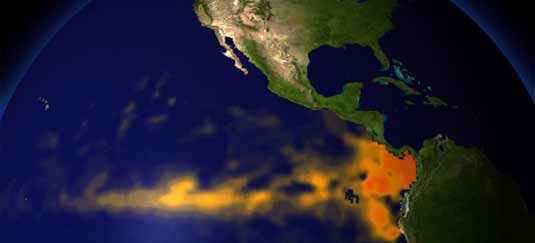
El Niño
The global weather anomaly hit the
Galapagos hard. While an entirely natural occurrence, the
weather pattern took a vital part of the ecosystem out of
the chain. Many fish searched for different waters to feed
upon. The fur seals were most greatly affected as they depend
on the fish closer to the surface. The surface waters were
heated more during the attacks of El Niño, and the
fur seals between ages 1-4 were virtually all wiped out. El
Niño also affected coastal birds. The absence of fish
in the coastal waters meant that many of the traditional nest
areas for birds were abandoned.
Human Impact
While this unforgiving and uncontrollable force of nature
has had a destructive impact on the Galapagos, many of the
environmental issues facing the Galapagos originate from a
potentially controllable source --human beings. The presence
of people in the Islands has two sources: migration from the
mainland and tourism.
- Migration and
Hawaiianization
Hoping to find work, people from mainland Ecuador have literally
invaded the Islands. The Galapagos population has increased
over 300% in the past few decades. The 1990 census marks
the population at 9,735. Today, more than 20,000 people
live on the Islands. The population is doubling every eleven
years, which means that there will be 40,000 people on the
Galapagos Islands by 2014. This affects the archipelago
in a number of means. Aside from the pressure put on the
natural resources, this large growth means that most of
the garbage is dumped in an open air site and burned with
no sort of treatment or separation.
- Tourism
For decades, tourists have marvelled at the rich flora and
fauna of the Galapagos. Despite the high prices, the stream
of visitors has never broke off. In the sixties, there have
been about 1,000 tourists per year, whereas there have been
approximately 80,000 visitors in 2001. A second airport
was built and the construction of a third one is under discussion.
The park service does a remarkable job of regulating the
licensing of guides, as well as designating low-impact landing
sites. The National Park charges a $100 entrance fee on
foreign tourists, yet receives only 25% of that. Nevertheless,
the park has to deal with the conservation problems that
motor yachts and their trash bring to the island.
- Over-fishing
Recently, overfishing or illegal fishing has become a large
issue. When migrants do not find work in tourism, they often
find jobs in the fishing industry. The sea cucumber and
sharks of the Galapagos have become alarming targets, both
popular in Asian markets for their aphrodisiac or medicinal
qualities. Due to the alarming decrease in the early 1990's
an Executive Decree enforced by the National Park service
banned all fishing of sea cucumbers in the Galapagos. Fishermen
were not filled with enthusiasm. Although the ban has been
replaced by a quota, there have continuously been strikes
on the part of the fishermen. Only recently, in April 2004,
angry fishermen besieged the Charles Darwin Station and
demanded the right to use greater nets and longer lines.
The seizure ended with an agreement signed between César
Narváez (Ecuador's Minister of the Environment),
and the artisenal fishermen. The conflict, however, is far
from over.
Who came to the Islands first? Find out
more about the human or also
called modern history of the Galapagos Islands.
Introduced Species
The mere human presence of people alone does not hold such
a severe threat to the native
species. After all, its humans did not arrive alone. Since
the times of the first inhabitants, non-native species have
been imported to the Islands, often with drastic consequences.
Many of the species introduced are not rare or deadly in themselves,
but when placed on fragile Islands where life took years to
adapt, mere rats, dogs, cats, and goats have dramatic effects.
Feral dogs, most likely imported to the Islands as mascots
of early settlers, have been a threat to tortoise eggs, native
iguana species and even penguins. Four goats were introduced
to the Santiago Islands in the early 1800's, went rampant
and one estimate calculated that their population had grown
to nearly 100,000. Due to their constitution and ability to
feed on nearly any plant, goats alone may be responsible for
the local extinction of up to 4 or 5 species of vegetation
and compete with the Galapagos tortoise for their food source.
A newly introduced wasp species has been sited on the Islands,
and may be responsible for a declining number of caterpillar
larvae, a food source for finches. The Charles Darwin Research
Station constantly searches for solutions to the problem of
introduced speicies. To find out about this and other projects
they are working on check out their website.
Positive Future
(?)
While there are a great number of issues and problems facing
the fragile environment of the Galapagos, there are success
stories and potential solutions as well. The introduced eradication
program, though slow going, has eliminated feral goats from
several small islands. Dogs are now absent from the island
of Isabela. The efforts to reintroduce and repopulate species
such as elephantine tortoise have increased their numbers
dramatically. Environmental education efforts on the Islands
help their inhabitants understand the larger picture and need
for conservation, and responsible tourism and enforced park
guidelines help preserve the Galapagos for the future. But
there are seemingly endless needs for the park's preservation,
and always limited funding. Other than what little budget
it receives from the Republic of Ecuador, the National Park
relies entirely on funding from philanthropists, fundraising
efforts of the Charles Darwin Foundation, Inc. and other private
organizations.
How you can help
When you stop at the Charles Darwin Research Station during
your tour, feel free to leave a much appreciated donation.
The Charles Darwin Foundation, Inc. is the fundraising arm
of the Research Station and would more than greatly appreciate
your contribution. Visit their website at www.galapagos.org
and find out how you can help.
You or your organization, corporation
or business are strongly encouraged to contribute (most likely
tax-deductibly) to the preservation of the world heritage
that are the Galapagos Islands.
Park Rules
When you visit the Galapagos National Park, stick to the following
park rules to help preserve the unique flora and
fauna on the Islands. Do not remove any plant, animal, or
remains of such (including shells, bones, and pieces of wood),
or other natural objects.
- Be careful
not to bring any live material or food to the Islands,
or from one island to another.
- Make sure you do not touch, handle,
feed, or chase the animals.
- Do stay within the permitted areas
and only visit the Islands together with a licensed National
Park Guide.
- Do not leave any garbage or litter
on the Islands, or throw any off your boat.
- Do not deface the rocks.
- Make sure you do not buy souvenirs
or objects made of plants or animals from the Islands.
For more comprehensive information
on environmental issues, check out our links
page.
|
